

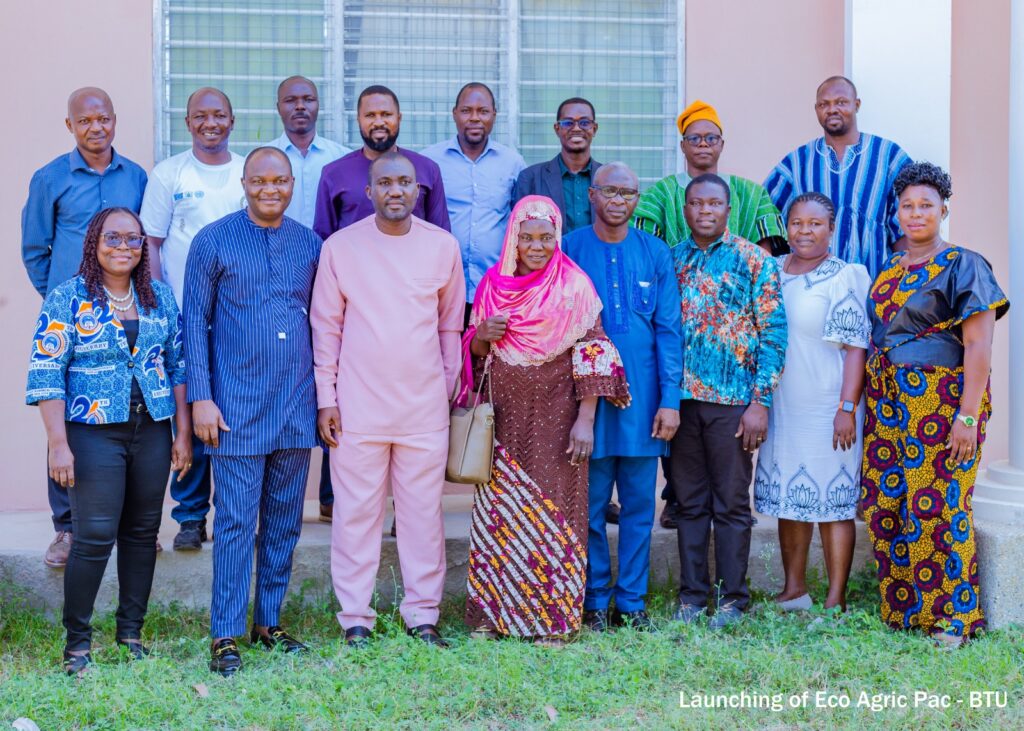
BTU Launches Programme Advisory Committee (PAC) for Ecological Agriculture to Strengthen Industry-Academia Collaboration
From Samuel Adadi Akapule, Bolgatanga
Bolgatanga Technical University (BTU) has inaugurated a Programme Advisory Committee (PAC) for its Ecological Agriculture (EAG) programme aimed at strengthening collaboration between academia and industry.
The launch, held at Sumbrungu, the main campus of the university, brought together industry players, development practitioners, faculty members, alumni, and representatives from partnering organizations.
The establishment of the PAC is supported by the United Nations Capital Development Fund (UNCDF) under the EU–Ghana Pact for Skills. It is one of three advisory bodies being created at BTU to enhance the relevance of the University’s programmes in the Technical and Vocational Education and Training (TVET) sector. Similar committees have already been formed for the Electrical and Electronics Engineering (EEE) and Computing and Information Technology (CIT) programmes.
Membership of the Ecological Agriculture PAC is entirely external, consisting of 11 prominent individuals drawn from industry, alumni, and non-governmental organizations. The Committee is chaired by Mr. Samuel Abasiba, a seasoned development practitioner with extensive experience working in the Upper East Region.
The other members include Hajia Memunatu Alhassan of Lowland Rice Company, Tamale, Ms. Amoah Jennifer Atogsira of the Women in Agricultural Development Directorate (WIAD) of the Ministry of Food and Agriculture (MOFA) at the Talensi District Assembly, Sylvester Minyila of Minssap Ventures, Bolgatanga, Matthew Akayeti Naamlebna of Hights Enterprise Limited, Bolgatanga, Dominic Anarigide of Irrigation Company of Upper Region (ICOUR) Limited, Maxwell Akandem of Akandem Farms Limited, and Dr. Jacqueline Onumah (Head of Department of EAG at BTU), who serves as Secretary to the Committee, Emmanuel A. Aziiba of the Council for Scientific and Industrial Research – Savannah Agricultural Research Institute (SARI) at Manga, Dr. Daniel Y. Nang of Dansyn ISO Limited, and Vincent Subbey of TRAX Ghana. Among the members are two women actively engaged in the agribusiness value chain.
In his opening remarks, the Pro Vice-Chancellor of BTU, Prof. Peter Osei Boamah, expressed profound appreciation to UNCDF for facilitating the formation of the advisory committees, which he described as a pivotal step in advancing BTU’s strategic vision.
According to him, the PAC forms a vital link between the University and the industries it serves, ensuring that both academic content and graduate skills remain up-to-date, market-driven and responsive to the evolving needs of employers.
Mr. Alexis Adugdaa Ayamdor, Project Lead, noted that the committees would provide timely and constructive feedback on programme quality and would play key roles in enhancing curriculum relevance, improving teaching and learning, and boosting graduate employability.
He explained that the PAC will help BTU integrate industry expertise directly into curriculum development and programme delivery. “It will support the design of experiential learning opportunities, strengthen student recruitment strategies, and provide insights into the skills and behaviours required for success in the labour market’, he stressed.
Mr. Ayamdor added that the Committee will advocate for BTU within industry networks, help secure resources such as equipment, scholarships and training opportunities, and assist in creating pathways for internships, apprenticeships, entrepreneurship, and other forms of work-integrated learning.
The PAC’s responsibilities are broad and strategic. It will help identify educational requirements for job placement, arrange field trips for students, assist in labour market surveys, and facilitate part-time or cooperative work opportunities to enhance students’ practical training.
The committee will also provide information on available employment prospects, advise on faculty professional development, support resource mobilization efforts, recommend state-of-the-art laboratories, tools and equipment for the department, and guide the review of programme content to ensure it remains current with industry demands.
Additionally, it will evaluate the department’s facilities, propose curriculum updates where necessary, help establish competency standards for both faculty and students, and remain accessible to accreditation and evaluation bodies.
The Ecological Agriculture PAC is expected to significantly strengthen BTU’s engagement with industry, particularly in areas such as curriculum advisory support, student internships, applied research, resource development and employer partnerships.
Through this collaboration, the University hopes to produce graduates who are not only technically proficient but also ready to succeed in the increasingly competitive and dynamic agricultural sector.
The Chairman concluded by describing the launch as the beginning of a transformative journey for BTU and its partners and called on members of the Committee to bring their expertise, networks and commitment to bear on the development of the Ecological Agriculture programme.
The ceremony ended with a renewed commitment from both the University and industry stakeholders to work together to advance ecological agriculture training and contribute meaningfully to national development.
The Chairman of the PAC Committee, Mr. Abasiba, gave the assurance the Committee members will work assiduously to justify the confidence reposed in them.
CONTACT
- Bolgatanga Technical University Post Office Box 767 Sumburungu, Bolgatanga Ghana, West Africa
- +233 0382097551
- registrar@bolgatu.edu.gh
- GHPost GPS Address: UB-0964-8505
The University
Copyright Bolgatanga Technical University © 2026 All Rights Reserved